For those who frequently travel for business or leisure, a hair clipper has become a near-essential tool, especially for those who need to maintain a professional appearance. However, with increasingly stringent airport security regulations, many people are concerned: Can hair clippers be brought on board? Should they be carried on board or checked in? If so, how should they be packed? This article will provide detailed answers to these questions based on the latest Transportation Security Administration (TSA) regulations, while also sharing some practical travel tips.
1. Core regulations: Can hair clippers be brought on board an airplane?
The answer is actually quite simple – yes. For most domestic and international flights, you can definitely bring it on board. The main issue is with different types of hair clippers, especially cordless models with lithium batteries, which are often the focus of security checks.
The latest TSA regulations for 2025 state:
- There are no explicit “no carry” clauses for all types (including corded, cordless, and electric);
- There are no special requirements for corded hair clippers, they just need to be packaged properly;
- Wireless models, such as rechargeable models, must comply with aviation safety regulations—typically, the battery capacity must be less than 100Wh (which most household appliances meet). Furthermore, it’s best to carry them with you to avoid safety hazards such as crushing during checked baggage. Some airlines even prohibit small electrical appliances with lithium batteries from being checked in.
Sounds a lot easier, doesn’t it? However, to avoid trouble at security, we need to make other preparations.
2. Packing Guide: Carry-on Baggage vs. Checked Baggage
How you pack, especially whether you choose to carry on or check in, directly impacts your security clearance process. Here are some tips to help you choose the best packing method.
1. Carry-on baggage packing: avoid accidental opening and easy inspection
The biggest advantage of putting a hair clipper in your carry-on luggage is that it avoids the risk of damage or loss during checked baggage. Moreover, when you carry it with you, you can use it at any time, so you can get a haircut anytime. When it comes to packing, the key is not to trigger the security alarm:
- Secure the device to prevent accidental activation: If it has a power switch, make sure it is off. You can wrap tape around the switch to prevent accidental activation. Alternatively, place the hair clipper in the secure slot inside the box to prevent it from being accidentally activated.
- Protect sharp parts: For detachable blades and trimming combs, it is best to place them in a protective case or soft cloth bag (if available, use the blade cover that comes with the product). This will not only prevent scratches on other luggage, but also make security personnel feel more at ease.
- Battery handling: If it’s a wireless model, it’s recommended to charge it to half capacity in advance to avoid the risk of storing it fully charged. If the battery is removable, it’s best to remove it separately and place it in a dedicated battery compartment—this is not only safer but also prevents short circuits.
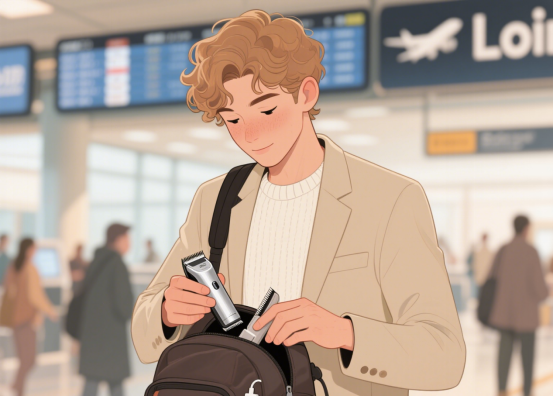
- Easy access: Place your hair clipper in the top or side pocket of your carry-on baggage so you can quickly retrieve it if security asks to check it, avoiding delays.
2. Checked luggage packing: prevent damage and accidental injury
If you are checking in, there are relatively fewer restrictions, but the equipment may be squeezed during transportation, causing damage. Here are some packing tips:
- Hard packaging cushioning: Try to choose a hard-shell storage box, or wrap a layer of bubble film around an ordinary storage bag to avoid damage caused by squeezing during transportation.
- Secure sharp parts: Hair clipper blades, small scissors and other sharp parts are best wrapped in thick cloth and then placed in a bag separately to avoid causing harm to baggage handlers and scratching other items.
- Labeling tip: You can put a note on the storage box and write “Hair clipper (personal grooming tool)” to help security personnel quickly identify it and reduce the possibility of opening the box for inspection.
- Weight limit: Hair clippers (including charger and accessories) typically weigh 0.5-1kg, so remember to factor this into your checked baggage allowance. If you’re travelling in economy class, the usual checked baggage limit is 23kg; any excess baggage will incur a fee.

3. TSA security inspection process: How to pass the inspection smoothly?
Even if you pack your hair clipper in advance, it may still trigger the security alarm due to the metal parts. But don’t worry, follow these steps and cooperate with the security check, and you will basically be able to pass through the customs smoothly:
- Actively cooperate with the inspection: If the security personnel ask you to take out the hair clipper, you should quickly take it out of your carry-on luggage, show it to the staff, and tell them that it is a household hair clipper.
- Keep your device clean: Remember to clean out any hair and debris before departure . Dirt can cause security personnel to misunderstand the nature of the device, increasing inspection time.
- Subject to additional inspection: If the device triggers an alarm, the TSA may scan it again with a handheld scanner or check to see if the blade meets the criteria for a “non-regulated knife.” Household blades are generally less than 6 cm long, so there’s no need to worry.
4. Travel Tips: Improve Carrying Experience
In addition to ensuring compliance with regulations, taking care of these small details can give you more peace of mind:
- Check the rules in advance: 1-2 days before departure, log on to the TSA official website or the website of the aviation security agency of the destination country to confirm whether there are any temporary adjustments, such as stricter security requirements during holidays.
- Choose a portable model: If you can choose a compact hair clipper that supports dual voltage (100-240V), it will be more convenient. It is not only suitable for carrying around, but also can be used directly when traveling internationally.
- Keep accessories minimal: Only bring the 1-2 most frequently used trimming combs and a cleaning brush. Avoid carrying too many small accessories that might get lost. Small accessories can be stored together in a sealed bag.
- Mark your checked luggage: If you decide to check in your luggage, remember to put your personal contact information on the storage box to avoid being unable to find your luggage if it is lost.
5. Carry-on or checked luggage? Weighing the pros and cons
| Carrying method | advantage | shortcoming |
| carry-on luggage | Avoid equipment damage and loss;No need to wait for checked luggage;3. Can be used anytime (e.g. touch up after a long-haul flight) | 1. Occupy carry-on baggage space;2. You may need to cooperate with security checks;3. Lithium batteries must comply with carry-on regulations |
| Checked baggage | Does not take up any space in your carry-on bag;2. Take it out separately when no security check is required;3. Can be equipped with a full set of accessories | 1. Risk of damage or loss;2. Lithium batteries may not comply with shipping regulations;3. Need to wait for baggage claim |
6. Special Reminder for International Flights
Hair clippers are permitted in most countries, but please be aware of the following:
- Lithium battery restrictions: Some countries (such as Japan and Australia) have stricter requirements for the capacity of lithium batteries in carry-on baggage, generally requiring them to be less than 100Wh, and they must be declared separately. Before departure, remember to print out the battery data sheet for future reference.
- Entry regulations: Some countries (such as parts of the Middle East) have strict inspections on “sharp tools” and they may be subject to special inspections. It is recommended to keep the purchase receipt to prove that it is a personal item rather than a professional tool.
- Voltage adaptation: If the voltage at your destination is different from your home country (e.g. 110V in the US, 230V in Europe), be sure to confirm whether it supports dual voltage to avoid device damage caused by voltage mismatch.
Summarize
As long as you follow airline safety regulations and pack appropriately, hair clippers are perfectly safe to bring on board, helping you maintain a neat and professional appearance while traveling. While airline safety regulations are becoming increasingly stringent, understanding them and packing carefully is a breeze. Remember to pay attention to lithium batteries, battery capacity limits, safe handling of sharp parts, and specific regulations at your destination to avoid unnecessary hassles. Finally, I wish you a safe and pleasant flight!
Choosing our hair clipper not only allows you to maintain a neat image at any time during your travels, but also allows you to experience an efficient and convenient haircut experience. Whether it is for home use or travel, it can be easily handled, allowing you to say goodbye to the trouble of queuing at the barber shop!