
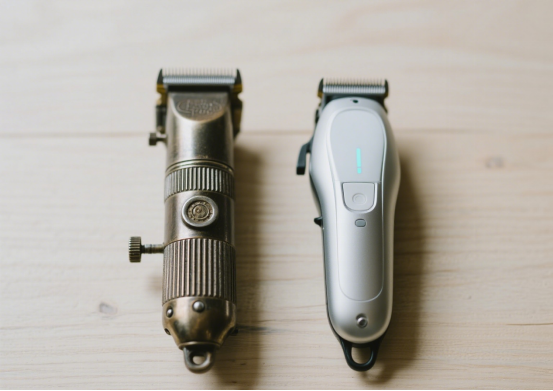
In today’s rapidly evolving era of smart technology, many people’s understanding of hair clippers seems to have transcended mere practicality. Modern, streamlined designs and smart features like Bluetooth connectivity and automatic adjustment have transformed hair clippers into highly effective tools that combine technology and convenience. However, looking back, particularly at metal hair clippers from the mid-20th century , their unique allure and historical significance have quietly burgeoned in the collector’s market, becoming a timeless cultural icon.
Industrial Design: From Mechanical Precision to Humanistic Warmth
The 1950s marked the golden age of American industry. Oster and Wahl released a series of classic models that remain coveted collectors’ items. Take the Oster Classic 76, for example. This hair clipper ‘s body is crafted from forged steel and weighs a hefty 1.2 kg, giving it a solid, substantial feel. Holding it in your hand, you can feel not only the coolness of the metal but also its stability and mechanical precision. The clickety-click sound emanating from the gears is like the unique background music of an old barbershop, resonating with the memories of an era. The weight isn’t accidental; it was intentional by the designers to balance the vibrations generated by high-speed operation, ensuring that barbers maintain stability and comfort during extended periods of operation.
Compared to the American industrial style, European design possessed a more decorative and artistic quality. The HS-2, released by Braun in Germany in 1957, was a prime example. Its intricate geometric patterns on the metal body and half-moon enamel buttons broke with traditional instrumental design, perfectly combining functionality and artistry. This design transcended the “instrumental” nature of hair clippers and became a cultural symbol, reflecting the rational aesthetics of postwar Germany.
The collection market: From a tool to a cultural carrier
As time goes by, the market value of vintage hair clippers continues to rise. Classic models from the mid-20th century, in particular, are often considered works of industrial design. Among these vintage pieces, the most prized are undoubtedly Oster’s “Golden A5” series. Introduced in 1955, the chrome plating on the blades remains as gleaming as new, reaching a thickness of 0.3mm and practically reflecting a mirror image. Due to their exceptional quality and enduring luster, intact “Golden A5” hair clippers often fetch upwards of $2,000.
It’s worth noting that collectors of vintage hair clippers also show generational differences. Older collectors often collect these older models out of professional memory . For many retired barbers, these items are not only a part of their careers but also precious relics that bear the marks of time. Younger collectors, on the other hand, are more interested in the design language and contemporary feel of these items. Many young people even recreate these classic pieces, transforming them into modern items like lamps and speakers, breathing new life into these vintage designs.

Cultural Symbols: Barbershops as a Mirror of the Times
Vintage hair clippers are more than just tools; they carry a deeper cultural and historical memory. From the old barbershops in movies to the social changes in reality, they have unique symbolic meanings in every era.
Hair clippers in films often serve as a crucial reflection of the era. For example, in the classic film “Once Upon a Time in America,” a 1920s manual hair clipper hangs in the barbershop frequented by Noodles . The carvings on the cast iron base echo the extravagant style of the Prohibition era, becoming a symbol of the era’s glitz and ambivalence. Similarly, in the scene where Forrest Gump gets a haircut before joining the army, the barber uses 1960s electric hair clippers . The plastic handles echo the era’s inexpensive materials and reflect postwar America’s pursuit of cost-effectiveness.
Furthermore, retro design has become a testament to social change. In the 1960s, barbershops in African-American communities began custom-making hair clippers emblazoned with African totems . These clippers, engraved with symbols of identity, became a key symbol of African-American culture. In the 1970s, the rise of punk culture led young people to cut electrical cords and plug in colorful light bulbs, transforming them into a symbol of rebellious spirit. Today, they no longer merely appear in nostalgic images; their designs have become a source of inspiration for the fashion world. At Gucci’s Spring/Summer 2023 show, stylists used 1950s Wahl hair clippers to create retro hairstyles for models, seamlessly blending past with present fashion.
Touching time: not just old things, but also the memory of the times
For many, vintage hair clippers might just be old items quietly languishing in a corner of their homes. They might be relics from a grandfather’s drawer, chance finds at a flea market, or even café wall decorations. Yet, these seemingly ordinary objects hold undeniable historical and cultural value. Every turn of them is like a journey back in time, echoing the stories of barbershops. They are more than just tools; they epitomize an era and bearers of collective memory.
When we touch these old metal surfaces, we may not be touching cold matter, but rather symbols of a time imbued with a sense of timelessness. They carry stories of the past, silently recounting the ingenuity of industrial design and the sublimation of aesthetics.